The Call Is Coming From Inside The House
The Federal Debt Is Frightening, Growing, and the Day of Reckoning Is Near

One of the most important inputs to housing affordability is the cost of money. When interest rates rise, the cost of home ownership rises for all buyers who must borrow to purchase. (Even cash buyers pay a cost since money tied up in a home is not invested elsewhere.) The connection is irrefutable.
A Fateful Data Marriage : The 10-Year Treasury and the 30-Year Mortgage
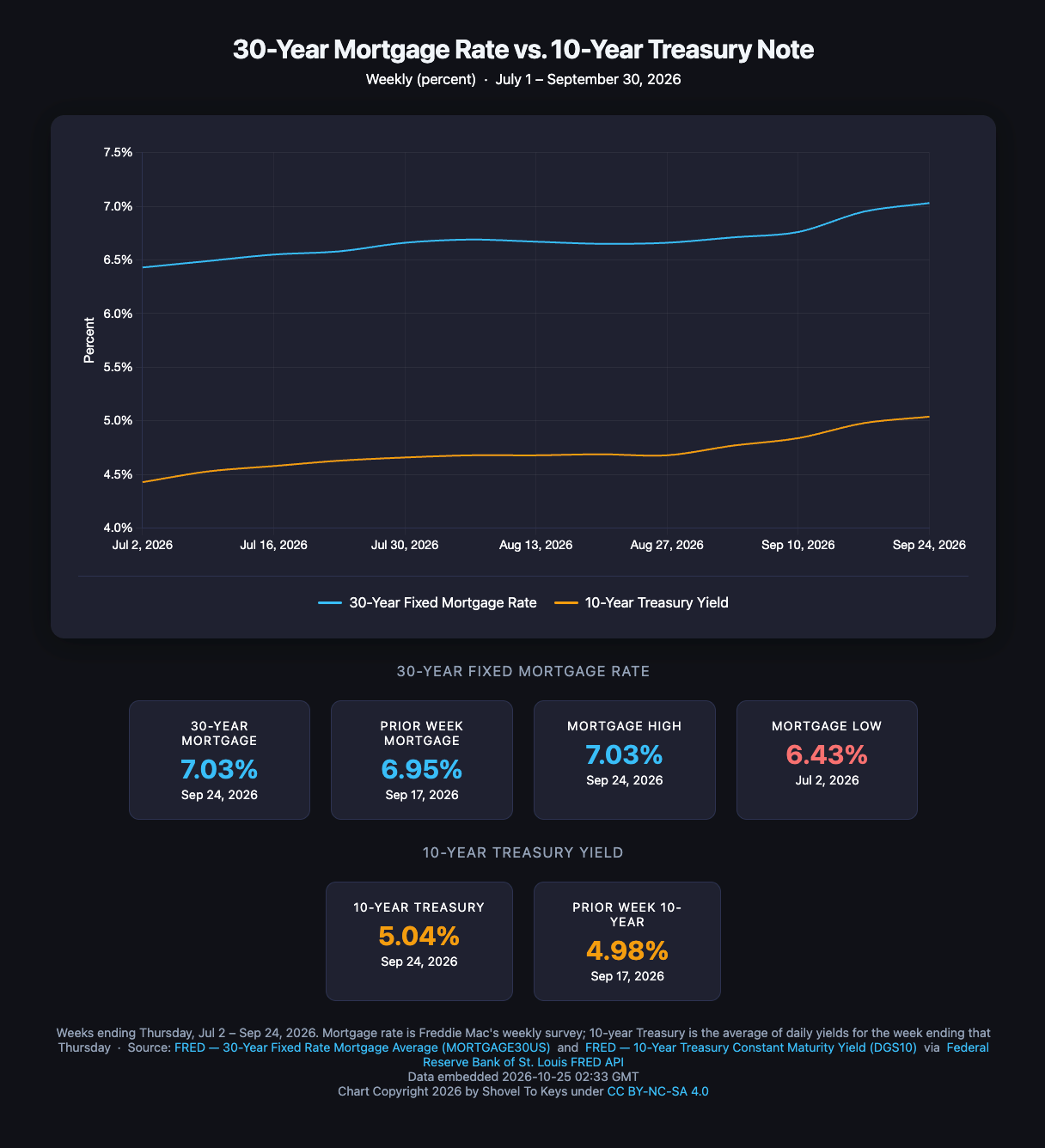
For many years, the cost of money for home buyers in the form of 30-year mortgages has been tied closely to the federal government’s cost of money in the form of 10-year Treasury notes. The home buyer cost of borrowing is tied to the credit-worthiness of the United States, which is a rate-marriage artifact discussed further below. The close relationship of the two rates is evident in the 26-year chart below.
The rate marriage was not compelled by an unhappy father with a shotgun. The marriage makes investment sense. The 10-year Treasury and mortgage-backed securities (MBS) based on the 30-year mortgage compete for similar investors; namely, investors seeking a fixed income with a duration of ten years. Although 30-year mortgages have a term of 30 years, the average actual duration is between seven and ten years.
As shown by the purple dotted line in the chart above, the spread between the 10-year Treasury and the 30-year mortgage has been stable for over 20 years with a few calamity-driven exceptions. During the Great Financial Crisis and the Covid pandemic, the spread jumped sharply from around 200 basis points (i.e., two percentage points) to 300 basis points. Investors perceived that these unusual events could create more risk for mortgage defaults (for example, because of job losses at the inception of the pandemic) but not more risk for U.S. government default.
When inflation began to rise in 2022, the Federal Reserve rapidly responded with interest rate increases. The rate on the 10-year Treasury and the 30-year mortgage followed as we would expect, but the spread between the 10-year Treasury and the 30-year mortgage increased significantly. The reason for the widening of the spread is not so obvious.
Fixed-income investors anticipated that the Federal Reserve would competently bring down inflation. With ultra-low mortgage rates a very recent memory in 2022, investors also expected mortgage rates would decline in parallel with inflation. Lower mortgage rates would provoke refinancing of mortgages originated during the hopefully short period of elevated Federal Reserve monetary policy. The higher likelihood of a swell of refinancing caused investors to demand a larger premium on the MBS backed by the mortgages that would be refinanced. The larger premium showed up as a wider spread between the 10-year Treasury and the 30-year mortgage.
The 10-year / 30-year spread has trickled lower over the past two and one-half years with intermittent but short-lived spikes. The declining spread aided a gradual but mostly steady decline in 30-year mortgage rates. From January 1, 2025 to February 27, 2026, the 30-year mortgage dropped almost a full percentage point, even though the 10-year rate had dropped only half as much.
And, what is significant about February 27, 2026? The Iran war (or is it a special military operation), which triggered a rapid, steep increase in oil prices and the inevitable uncertainty of military conflict. From just before the war began through the date of this post, oil prices have risen by approximately fifty percent (see the chart below) with fluctuations driven by Presidential forecasts of a “deal” or annihilation of Iran.
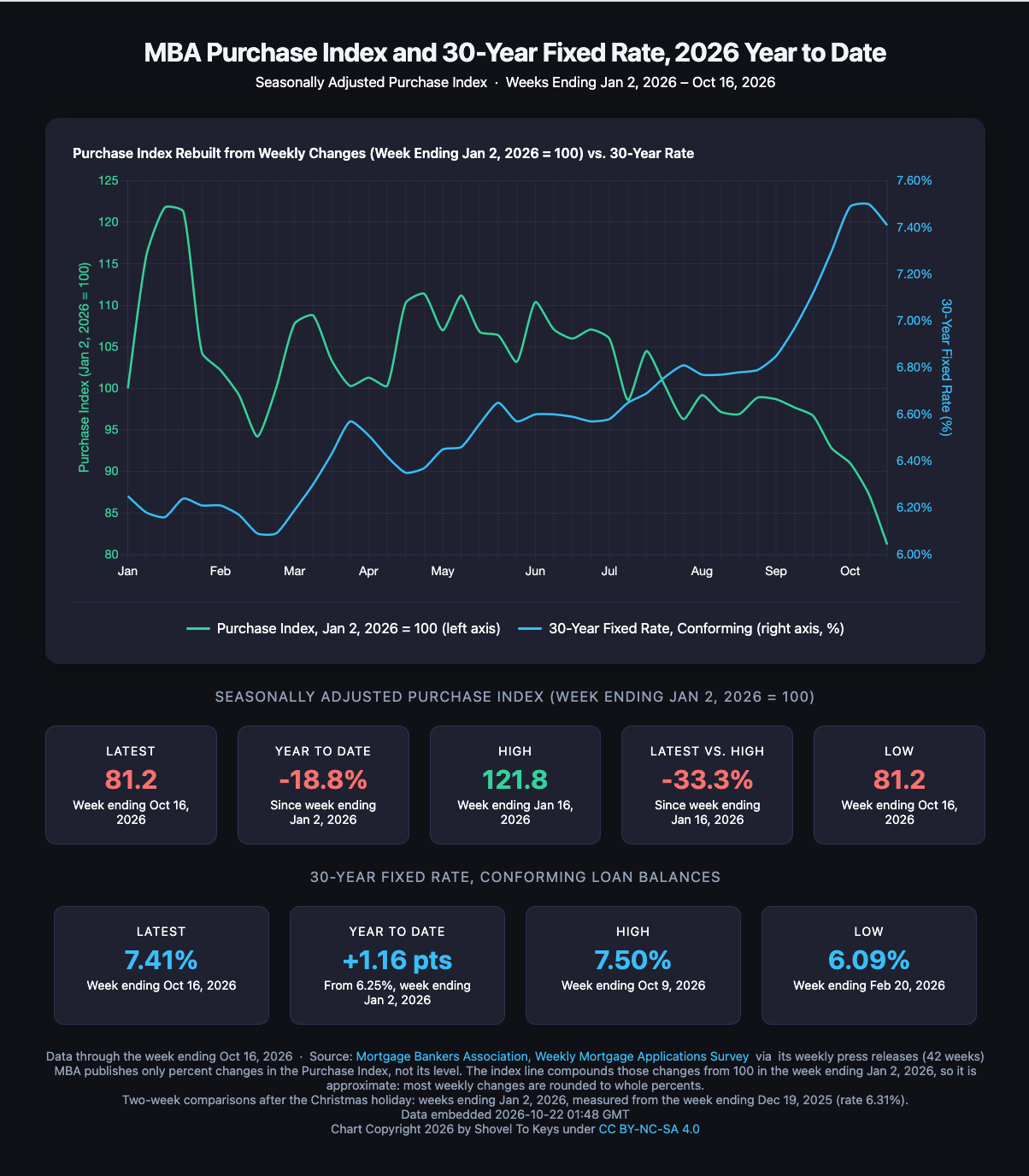
The 10-year Treasury rate has risen almost 50 basis points. The 30-year mortgage rate has risen by more than 50 basis points. Bond traders feared with prescience, given recent data, that higher oil prices would push inflation higher and endanger an anticipated Federal Reserve interest rate reduction late in 2026. Such a steep rate increase necessarily increases the cost of purchasing a home with a mortgage.
Rocky Times Ahead for the Rate Marriage
The marriage between home purchase borrowing cost and the credit of the federal government can be unhappy during unusual, short-term events. The unhappiness may turn to long-lasting agony and torment. More distant on the horizon than the Iran war is a threat to home ownership cost far greater than a hopefully short-term military conflict.
In a report released on June 4, 2026, researchers from the Wharton School at the University of Pennsylvania described an analysis of the sustainability of the federal debt. To quote the researchers:
“We estimate that the United States federal debt cannot rationally exceed roughly 210 percent of GDP as an outer limit. Under historical excess cost growth in healthcare, this outer limit is likely reached within 20 years; there is a 25% chance of reaching it in 14 years. Debt markets unravel earlier if beliefs about government repayment shift.”
In other words, by sometime between the year 2045 and 2051, the researchers forecast that
“[T]here [will be] no feasible future additional tax on broad-based labor income that can finance the interest payments [on the federal debt] at the returns demanded by financial markets.”
In other words, no feasible income tax on wages could be imposed at the day of reckoning that could fund the federal government’s payment of its interest expense, much less bring down the principal balance of the debt.
In calculating a 20-year to 25-year horizon, the researchers assume that investors will not realize the impending doom until the moment it occurs. In other words, investors will not gradually withdraw over the coming years from investing in federal debt and will not slowly demand higher interest rates on U.S. Treasury debt issuances. A more astonishing and patently ridiculous assumption is hard to imagine.
More likely, as the researchers admit, as the years close between today and the deadline for the federal government to experience an epiphany of fiscal responsibility, bond investors inevitably will become increasingly concerned with the possibility of a default by the United States on its trillions of dollars of debt. The bond investors either will demand a higher rate of return to hold the federal debt, especially longer-term debt (such as the 10-year Treasury) or will refuse to refinance the debt. Mortgage rates will rise. Home affordability will decline possibly precipitously.
Twenty years once was a long time in the life of this writer. Time has shortened. Perhaps Shovel To Keys is moving too closely to the speed of light and experiencing time dilation. More likely, I have substantial history watching the federal government kicking the debt can down the road again and again.
Many of us have descendants who will be home buyers in the next twenty years. We may have resources to assist our future generations to purchase a home, but few of us can pave a complete bypass around a mortgage. Whatever challenges exist for home affordability today will pale in comparison to those presented when investors no longer will purchase 10-year Treasuries because the government either has no ability to service its debts or has elected to inflate its way out of debt. The challenge will be compounded when investors decline to invest in 30-year mortgages no matter the rate because the mortgage guarantor — the federal government — is itself a poor credit risk.
To bring this post back to its beginning and one of the central themes of Shovel To Keys, the close relationship between the federal debt and the cost of financing a home purchase is a crucial but rarely, if ever, discussed component of home affordability. The irresponsible fiscal policy of the U.S. government will gradually and then more rapidly make a home purchase less affordable. Within the next 20 to 25 years, if a divorce does not occur of the 10-year Treasury / 30-year mortgage marriage, the cost of home purchase debt will exceed the reach of nearly everyone because the federal debt will exceed the capacity of the government to service, much less reduce, its debt.
Is there a path to divorce that is not tumultuous? Not in my experience.
Be warned that the Wharton paper, although short, is dense with economics lingo.