Declining Interest Rates Will Not Deliver Housing Affordability
The Spiking Treasury Yield, Inflation, And Federal Reserve Restrictive Rate Policy Will Be A Floor Under Mortgage Rates, Undermining Affordability Relief Through Lower Borrowing Costs

We offer our posts with live, interactive charts.
Updated September 18, 2026 at 1:15PM EDT
Maybe we are not wrong, at least according to one major new outlet (maybe a pay wall).
Timing is largely, but not always, a matter of chance. This post from Shovel To Keys is one of those exceptions. We did not get lucky to release this discussion of interest rates on the day after the Federal Reserve Open Market Committee made one of its most consequential decisions in our memory. We wrote this post and waited amidst growing inflationary pressure and prediction market confidence to hear whether the FOMC would raise the Federal Reserve benchmark rate for the first time in three years. Perhaps you have heard that the benchmark rate is now 25 basis points higher and likely to rise again before we say farewell to 2026.
We waited because the decisions of the FOMC are seen by many as a tool that can improve housing affordability by reducing the monthly cost of a mortgage. The importance of mortgage rates multiplies if Shovel To Keys is correct that housing supply is not deficient and that growing housing supply would be unprofitable and so cannot be a path to lower homes prices. The FOMC action today emphasizes the conclusion to this post that we wrote more than a week ago, not as clairvoyants but as historical realists. Lower mortgage rates would be an historical contradiction and an impractical expectation.
Recent Memory Spurs Hope For Lower Mortgage Rates
Much of the hope for lower mortgage rates is a by-product of our predilection to remember recent events far more strongly than the more distant past. In the context of mortgages, recent memory for many prospective home buyers, especially first-time buyers, is the post-GFC (Great Financial Crisis) era from 2008 to 2020 known to some as the Zero-Interest-Rate Policy (“ZIRP”) era. For the youngest of first-time homebuyers, recency might be the powerfully distorting but much shorter Covid ZIRP span from early 2020 to mid-2022.
First, we review the roughly fourteen years from the inception of the Great Financial Crisis to the rapid rise of inflation as mRNA vaccines rapidly diminished the threat of the Covid pandemic:
-
As the impact of imprudent mortgage lending practices began filtering into the housing market and economy in 2008, Federal Reserve Bank efforts to cushion the economy from recession pushed interest rates sharply lower;
- In July 2007 (before the collapse of Lehman Brothers and Bear Sterns), the Federal Funds rate was 5.25% and the 30-year mortgage rate averaged 6.70%;
- By December 2008, the Fed had cut its benchmark rate effectively to zero, and the 30-year mortgage rate was 5.29%.
-
The interest rate hangover from the sub-prime mortgage inebriation continued until October 2016. During those eight years:
- The peak Federal Funds, 10-Year Treasury, and 30-Year Mortgage rates were 0.40%, 3.85%, and 5.42%, respectively;
- The average of the three rates was 0.16%, 2.49%, and 4.20%, respectively.
-
From October 2016 to November 2018, as the housing market recovery gathered momentum, the Fed Funds, 10-Year, and 30-Year rates rose:
- From 0.40%, 1.76%, and 3.47%, respectively;
- To 2.20%, 3.12%, and 4.87%, respectively.
-
In the middle of 2019, the central bank eased rates in response to an emerging trade war between the U.S. and China and with the comfortable cushion of a 1.7% rate of inflation below the Fed’s target 2%.
-
The Federal Reserve’s modest, if not gentle, management of interest rates came to a dramatic end in early 2020 with the onset of the Covid pandemic, and by April 2020, the benchmark rate effectively returned to 0.0%.
- The 10-Year Treasury followed down to 0.66%;
- The 30-Year mortgage rate collapsed to 3.31%.
History Does Not Favor A Lower Rate Outlook
As the chart above and data summary below explain, the GFC hangover and Covid monetary stimulus were starkly inconsistent with the history of interest rates.
The fifty-five-year available history of mortgage rates illustrates the fourteen-year post-GFC anomaly:
- From 1971 to the present, the average 30-year mortgage rate was 7.68% and the median was 7.20%;
- Since April 1971, the 30-year rate was at or above 7.0% for 359 months and below 7.0% for 306 months;
- Change the 30-year threshold rate to 6.0%, and the month counts become 468 at or above 6.0% and 197 below;
- Of the 197 months below 6.0%, 88% were between January 2008 (the beginning of the GFC) and August 2022 (post-Covid inflation well underway).
The post-GFC 30-year mortgage rate depression was a distortion of the longer historical rate trend. History counsels that mortgage rates above 6.0% will dominate and that rates above 7.0% are a reasonable expectation.
Strong winds are blowing behind the sail of history to make mortgage rates above 6.0% even more likely. The current federal fiscal incontinence, political weakness, AI-driven stock market trends, AI data center construction debt issuance, tariffs, and inflation all will keep mortgage rates carrying a 6-handle or higher for quite some time. The action today of the Federal Reserve to raise its benchmark rate to between 3.75% and 4.0% and to signal another rate increase later this year reinforces skepticism that 30-year mortgage rates will fall soon, if ever. Without a crisis, the rates lingering in the post-GFC and Covid era recent memory of prospective home buyers are fantasies that will not be fulfilled.
Inflation Is A Floor For Mortgage Rates
Among the macroeconomic upward forces on mortgage rates, inflation may be the most easily analyzed and most relevant. Given that the majority of mortgages are sold to investors who have a wide choice of investments and who measure investment appeal in part by “real” return (i.e., return after deducting the effect of inflation), examining mortgage rates in the context of inflation is instructive.
Measuring inflation by the Federal Reserve preferred metric of the Personal Consumption Expenditures Index, inflation most recently measured 3.70% in July 2026. (The August measure of PCE will be released near the end of September.). To deliver a break-even return to an investor, the rate on a mortgage must be at least 3.70%, but break-even is not a compelling investment opportunity.
-
Since 1971, the median spread between the PCE and mortgage rates has been 3.81.
- At today’s PCE, the implied 30-year mortgage rate should be 7.51%.
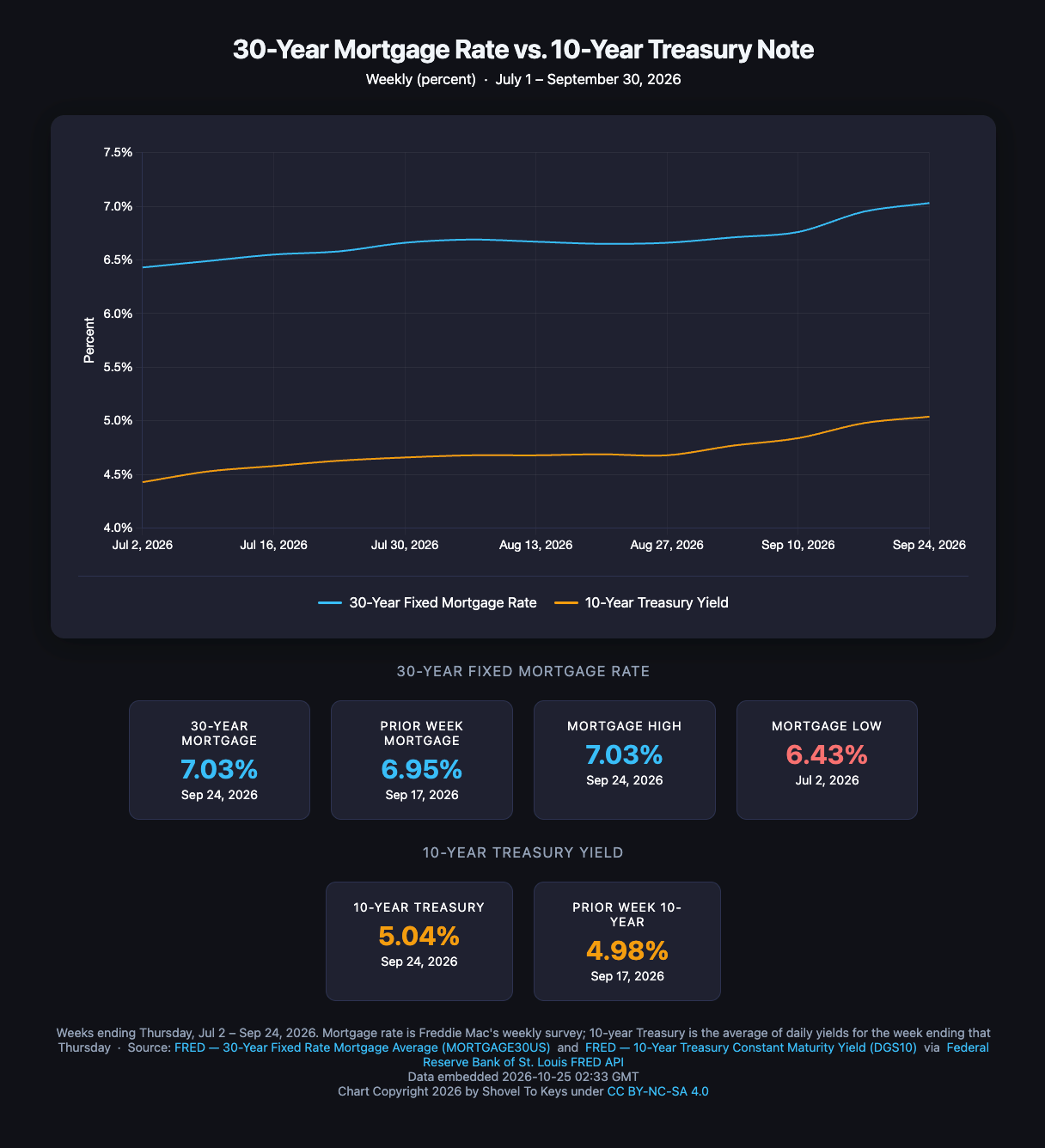
- When the markets closed on September 16, 2026 (the date of authoring of this post), the 30-year rate was 7.24%, according to Mortgage News Daily.
-
From January 2000 to the present, the median PCE was 2.12% and only 1.84% from January 2010 to the present, weighed down by the post-GFC ZIRP.
- In those same time periods, the median spreads between PCE and the 30-year mortgage rate were 3.02 and 2.53, respectively.
-
The PCE / 30-year spread in July was 2.84, well below the 55-year median of 3.81 and roughly between the 26-year and 16-year medians.
All of this is to say that recent mortgage rates have been consistent with or more favorable than the historical relationship between inflation and home purchase borrowing cost. Mortgage rates are not inappropriately elevated. Those rates fairly reflect the corrosive effect of persistently high PCE inflation. Until inflation diminishes predictably, we cannot expect mortgage rates to fall.
Even a downward trend in inflation may not be sufficient. Poor management of the fiscal affairs of the United States may create investor angst that any decline of inflation is transient or that the economy will falter. The result may be an increase in the PCE / 30-year spread, which undermines the housing affordability mission. Current events suggest exactly this outcome. As of the writing of this post in the aftermath of passing the $40 trillion federal debt milestone and the market manipulating failure by the U.S. Treasury, the 30-year mortgage rate is 7.19%, which is roughly 350 basis points above the July 2026 PCE.
The Fed Expects Declining Inflation But A Steady Benchmark Interest Rate
With yesterday’s hike of the Federal Reserve benchmark interest rate, the twelve voting members of the central bank’s rate setting committee are sanguine that inflation will decline substantially in 2027. In the FOMC’s Summary of Economic Projections released concurrently with the interest rate announcement, the consolidated outlook of the committee members is:
-
PCE inflation will end 2026 up 3.7% from the end of 2025 (despite a forecast in December 2025 of 2.4%), and the core rate (excluding food and energy) will be up 3.4%;
- At the end of 2027, PCE and core PCE will have risen 2.3% and 2.5% over that year;
- At the end of 2028, those figures will decline to 2.1% and 2.2%, fairly close to the central bank’s 2.0% target.
-
The committee member’s expect to vanquish inflation and sustain the victory over the long-run by holding the benchmark interest rate between 3.6% and 4.1% through 2029;
-
If the PCE / 30-year spread described above remains within the historical range between 2.53 and 3.81 and the FOMC forecast is accurate, we could anticipate a decline in mortgage rates:
- To between 4.83% and 6.1% by the end of 2027; and
- To between 4.63% and 6.04% by the end of 2028.
At first blush, the FOMC optimism might seem to be reason to hope for lower mortgage rates in the next 12 months, but history teaches that the folks at the Federal Reserve always believe that their monetary policy will tame inflation.
Trace the purple line in the chart above. From 2008 to 2021, the FOMC always forecast PCE inflation below its target rate of 2.0%. In the post-Covid escalated inflation environment, the committee members never forecast inflation above 3.2% (the 2023 forecast) despite a peak PCE year-over-year increase of 6.0% in 2022.
Call us skeptical. Considering the factors influencing inflation today that are beyond the central bank’s control (tariffs, the Iran War, AI build-out debt issuance, political uncertainty, and the federal deficit and debt), we believe that the FOMC inflation forecast aims too low and that the high end of those ranges are the best case scenarios. The central bank simply has too little control over the current drivers of inflation and the 10-year Treasury.
Inflation also is not the only floor for mortgage rates. Since 2000, the spread between the federal funds rate and the 30-year mortgage rate has averaged 3.19. For the next three years, the FOMC expects its benchmark rate to remain at 3.6% or higher. Even if the committee successfully lowers inflation, the very tool that it uses may block a decline in mortgage rates below 6.7% or so.
Without More Supply Or Substantially Lower Mortgage Rates, Our Search For Affordability Continues
More housing supply will not lower prices because profit is an inflexible, if not immovable, floor for prices. Mortgage rates travel on an escalator driven upward by persistent inflation, the federal funds rate, and deficits, tariffs, and AI spending. Federal legislative grandstanding, like the ROADS Act, nibbles at the margins of the housing market and tackles non-existent problems (e.g., corporate home buyers).
In our next post, we explore a mechanism already breaking the inertia of housing affordability. Little attention is given to the mechanism because its implementation is contrary to the long-term interests of dominant housing market players.
A Note About AI
Shovel to Keys is written by humans. Only humans. We use AI to perform calculations and produce charts, but the words in every post come entirely from neurons not neural networks.